
Mali's defence minister killed in its 'most secure' town — what changed on 25 April?
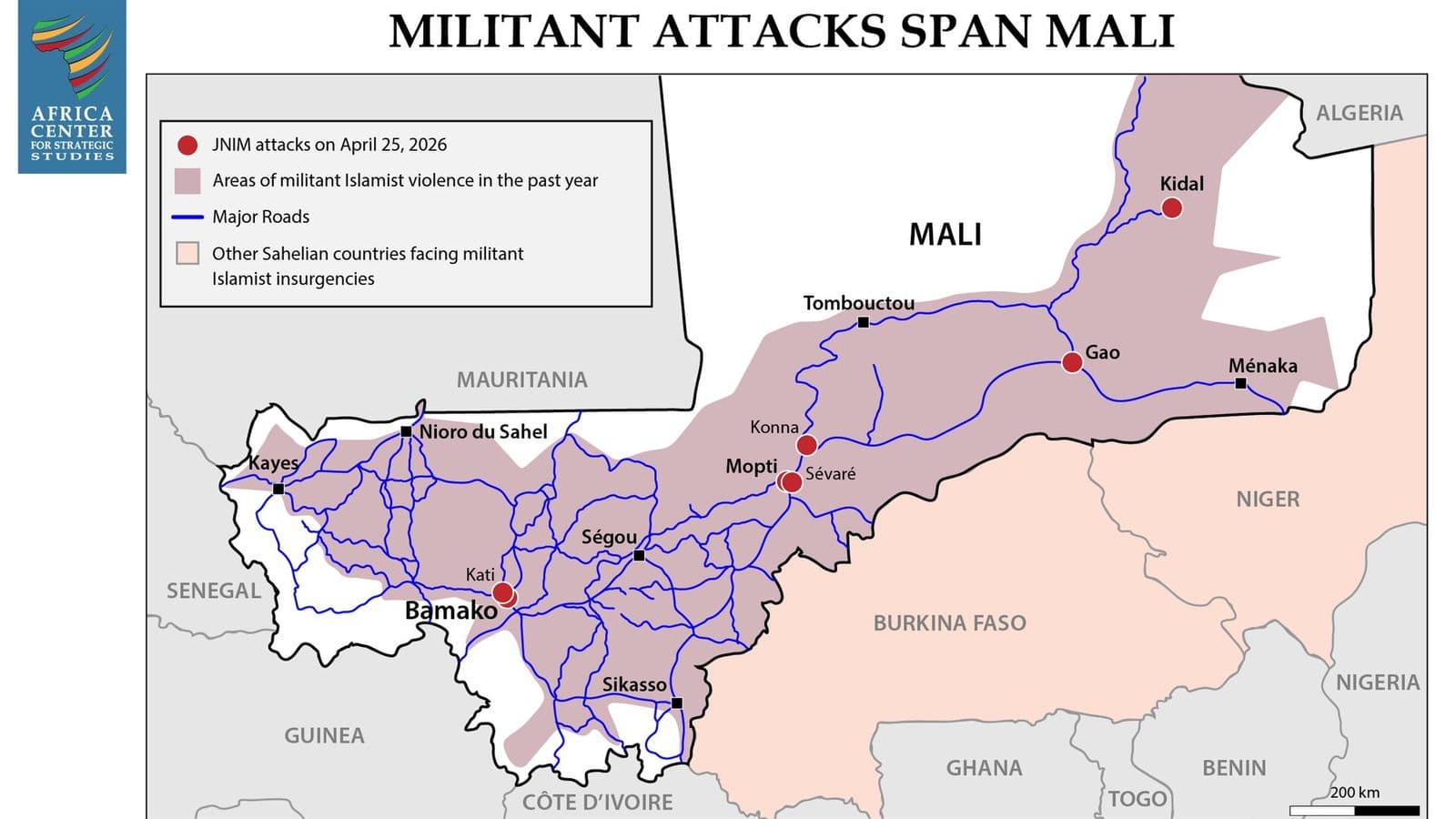
On Saturday, 25 April 2026, a car laden with explosives and driven by a suicide attacker hit the residence of Mali's defence minister, General Sadio Camara, in Kati, the garrison town about 15 km from Bamako where the army's main base is located. A firefight followed. Camara was injured and later died in hospital, government spokesperson Issa Ousmane Coulibaly said on state television the next day, according to Reuters.
AFP reported that Camara's second wife and two of his grandchildren were also killed, Al Jazeera wrote.
Kati "is considered one of the most secure locations in the country," Al Jazeera's correspondent Nicolas Haque said. The attackers reached the home of a man Haque called "one of the most influential figures within the ruling military leadership". Reuters wrote that the attacks show the government has not delivered the greater security it promised.
What happened on 25 April?
Analysts and diplomats described the operation as one of the largest coordinated attacks in Mali in recent years, Reuters reported. The al-Qaeda affiliate Jama'at Nusrat al-Islam wal-Muslimin (JNIM) and the Tuareg-dominated Azawad Liberation Front (FLA) struck simultaneously in more than half a dozen places, and both groups claimed the attacks.
Reuters listed Kati, the area near Bamako airport, and localities including Mopti, Sévaré and Gao. Al Jazeera also named Bamako and Kidal in the north. Residents told Haque that heavy gunfire and loud explosions could still be heard in Kidal on Sunday, and that the operation was continuing "more than 24 hours after it began".
Interim President Assimi Goïta also lives in Kati. Haque said he was moved to safety when the attack began, was "alive and well in a secure location" and remained in command. The government declared two days of mourning.
Camara was a central figure in the military government that took power after the coups of 2020 and 2021. Haque said some saw him as "a possible future leader of Mali".
Why are jihadists and Tuareg rebels fighting side by side?
The two groups have fought each other in the past. The analyst Bulama Bukarti told Al Jazeera that they "came together last year" and agreed to cooperate, and that recent days showed "the actual implementation of this agreement".
He also stressed that the alliance has limits: "These are two groups fighting for different objectives." JNIM is linked to al-Qaeda; the FLA is a Tuareg rebel group whose former stronghold is Kidal, in the north.
Who holds Kidal?
This was the most disputed point in the first days. The FLA said Kidal, its former stronghold, had fallen. A spokesperson wrote on X that a deal had allowed Russian fighters to leave a besieged camp outside the city where Malian forces remained, Reuters reported.
Army chief of staff General Oumar Diarra told the state broadcaster that the military had "tactically repositioned" its forces in Kidal and that operations were ongoing. Reuters could not confirm the city's status.
On 27 April, Russia's Africa Corps, a paramilitary force controlled by Russia's Defence Ministry, confirmed on Telegram that its units had left Kidal after fierce fighting, together with Malian army personnel, Reuters reported. It called the move a "joint decision" with Mali's leadership, said the wounded and heavy equipment had been evacuated first, and added: "The situation in the Republic of Mali remains difficult."
What does this mean for Russia's role?
Russia backed Mali's military government after it expelled French, US and other Western forces. "For Russia the attack has been a disaster," Ulf Laessing of the Konrad Adenauer Foundation told Reuters.
Russian state broadcaster Vesti offered a different account: it said the Africa Corps had repelled a large-scale attack and helped prevent the seizure of the presidential palace, with some of its members wounded. Russian war bloggers played down the Kidal withdrawal and said the force could return if necessary, according to Reuters.
What came before?
The offensive did not come out of nowhere. In September 2024, JNIM attacked a paramilitary police training school near Bamako airport, killing about 70 people. More recently, it imposed a fuel blockade that has deprived residents and businesses in the capital of power and supplies, Reuters noted.
What we do not know
- The death toll. The government released no overall figure. Its spokesperson offered condolences to "all civilian and military victims" without giving a number.
- Control of Kidal. The FLA claimed the city; the army spoke of a tactical repositioning; Africa Corps confirmed only that it had withdrawn. The sources we opened do not establish who held the city afterwards.
- Russia's part in the fighting. Vesti's account of the Africa Corps defending the presidential palace has not been independently confirmed.
What to watch next
Bukarti expected "more battles for control of territory and strategic locations". The African Union, the Organisation of Islamic Cooperation, the US Bureau of African Affairs and the EU condemned the attacks, and the UN Secretary-General said he "strongly condemns these acts". The UN called for an international response to violence in the Sahel. Whether the JNIM–FLA cooperation lasts, given their different aims, will shape what comes next in northern and central Mali.
Sources
- Al Jazeera: Mali's Defence Minister Sadio Camara killed during coordinated attacks (26 April 2026)
- Reuters (via Internazionale): Mali defence minister killed in major weekend assault (26 April 2026)
- Reuters (via Internazionale): Russia's Africa Corps confirms withdrawal from Mali's Kidal (27 April 2026)
Related articles
Comments (0)
Sign in to join the discussion.
- No comments yet — be the first.