
From a school gate in Créteil to 550,000 in the streets: what is France's protest wave now about?
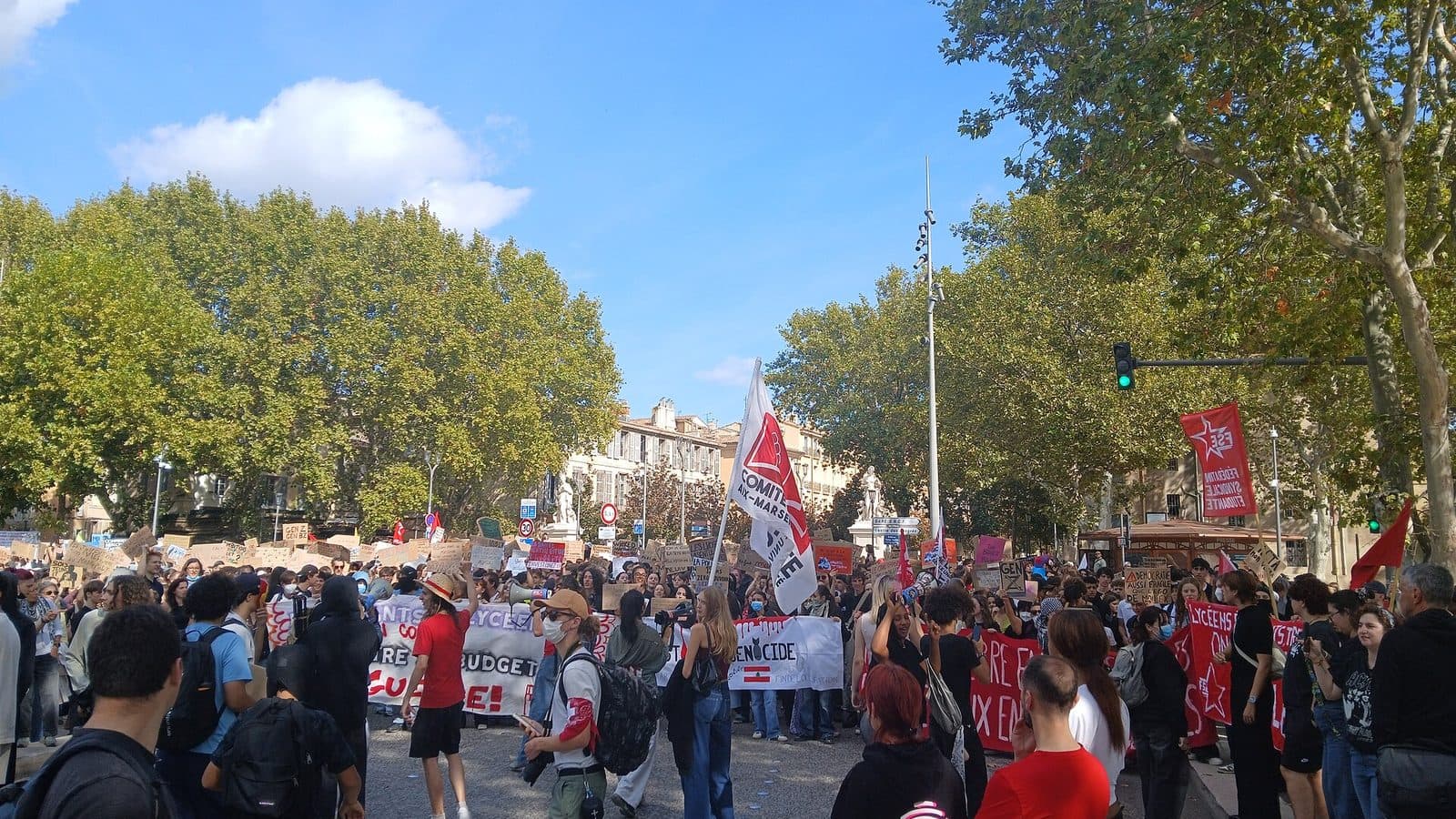
On 21 September 2026, students, parents and teachers gathered at the gates of the Lycée Saint-Exupéry in Créteil, a suburb of Paris, to demand more money for education, according to Amnesty International France.
Twenty-six days later, on Saturday 17 October, the town hall of Limoges was burning. The prefect, Maurice Barate, said “a wild horde” had deliberately set the 143-year-old building alight, France 24 reported. In Saint-Étienne, a 17-year-old lost a hand to what appeared to be a crowd-control grenade.
What began as a dispute over crowded classrooms and missing teachers has merged with anger over fuel prices and the cost of living, about six months before the April–May 2027 presidential election, AFP noted. The headline numbers of 17 October — how many marched, how many were arrested, how many were hurt — depend on who is counting, and some changed several times within 24 hours. This article sets out what the sources say, where they disagree, and the dates already fixed. It reflects reporting as of 18 October 2026.
How did one school blockade become a national movement?
After Créteil, students at other schools in the Paris region began blocking their own lycées, and within days the movement had reached Lille, Lyon, Marseille, Nice, Nantes, Rennes, Bordeaux and Tours, Amnesty wrote. Al Jazeera dates the start more loosely, to “mid-September”.
The complaints were concrete: unfilled teaching posts, overcrowded classes, buildings with collapsing walls, rats and mould, and too few school nurses and social workers. Amnesty cites one classroom at 39°C with a single fan for 37 pupils. A Marseille teacher told France 24 she had 37 students in her class and had to send them to neighbouring rooms for spare chairs.
The response hardened fast. On Thursday 1 October alone, police and gendarmes made 1,949 arrests, most of them students, and 305 officers were injured, according to interior ministry figures reported by France 24. More than 160 schools were shut that day.
Then came the injuries to teenagers that changed the tone. On 5 October in Lens, a 15-year-old lost his left hand after a stun grenade exploded near a lycée; the prosecutor confirmed the injury and the police watchdog, the IGPN, opened an inquiry. In Tours, a 16-year-old lost the use of his right eye, likely from a rubber-ball round, according to the prosecutor, Amnesty reported. Amnesty France's president, Anne Savinel-Barras, said the organisation was “alarmed by the police repression of the student movement”.
Who joined the students — and where does fuel come in?
By Tuesday 13 October, unions counted about 480,000 people at a new national day of protest; the interior ministry counted 161,500, including 41,500 in Paris, France 24 reported. Greta Thunberg joined a march near Paris: “Our future is being stolen from us.”
A second grievance was building at the pump. On 20 September diesel reached a record national average of €2.41 a litre, nearly 20% above early-2026 levels, the Journal de l'Économie reported, linking the rise to a Middle East conflict that had slowed tanker traffic through the Strait of Hormuz. Economy minister Roland Lescure ruled out cutting fuel taxes or freezing prices, citing public finances, the paper said.
The call for 17 October did not come from a union. It began with a viral TikTok video by a young man angry about pump prices, and was not organised by the original 2018 yellow vest leaders, France 24 found. “No Yellow Vest was behind the (October 17 protests),” said Jérôme Rodrigues, one of the movement's best-known figures. Several former yellow vest figures said they were reacting to police violence against high-school students.
Others followed. Environmental groups and a farmers' union called on members to take part, and the CGT, France's largest union, said it would join “wherever the conditions are met” while focusing on its own strike day, France 24 reported. The online call invited teachers, students, workers, pensioners and farmers to “yellow and youth” demonstrations, according to AFP. Al Jazeera saw nurses, human rights lawyers, firefighters, parents and teachers in the crowds.
Nobody agreed on how big it would be. A map on the organisers' website listed more than 1,000 events (France 24); AFP counted more than 600 demonstrations on a website; Al Jazeera cited more than 1,750 planned locations; a source close to the interior minister estimated around 250 actions (France 24). The day before, a police source expected nearly 200,000 people nationwide (AFP).
How many people marched on 17 October?
Interior Minister Laurent Nuñez put the figure at about 550,000 nationwide, including 110,000 in Paris, France 24 reported. The CGT said about 800,000, a figure also reported by Euronews. We found no independent count; both figures are given here as their authors gave them.
On either count it was larger than the 13 October day, and the ministry's own figure was almost three times what the police source had predicted. Then the marches turned.
What happened in the streets?
In Paris, Place de la République was packed and tense from 2pm; protesters threw firework mortars at police and set a car and a newspaper stand on fire, Al Jazeera reported. Clashes reached Rue Cambacérès, about 400 metres from the Élysée Palace, according to a Le Parisien reporter quoted by France 24. Protesters entered the town hall of the 10th arrondissement, where about 100 people were trapped at a Pink October event.
Elsewhere, town halls in Marseille and Lille were broken into, a tourist office in Lyon was set on fire, a police compound in Bordeaux was vandalised, and flames reached the roof of Limoges town hall, Euronews reported. Shops were looted in Paris, Marseille, Nice, Bordeaux and Lille.
Alexandre Bompard, president of the retail and trade federation, told LCI that about 1,500 shops were damaged, many of them looted, at a cost of “several hundreds of millions of euros”, according to France 24. Paris police said a demonstrator died of “cardiorespiratory arrest” during the Paris protests, without giving further details.
The Saint-Étienne case reopened the fight over police weapons. Stun grenades had been suspended during the student protests after the Lens injury; on 16 October Nuñez said they could be used in “extremely serious urban violence” (AFP). After the boy lost his hand, the prosecutor asked the IGPN to investigate. Nuñez said the grenade may have been used by the gendarmerie but that he “cannot confirm that”, France 24 reported.
Why do the arrest and injury figures not match?
Because they were given by different authorities, hours apart, for different areas. In the order they appeared:
- Evening of 17 October: Nuñez said about 400 arrests, mostly adults (France 24; Al Jazeera reported “at least 400”).
- Late on 17 October: Prime Minister Sébastien Lecornu said 1,200 arrests nationwide and 150 police injured.
- Morning of 18 October: Paris police said 855 people were detained in the capital, a “record figure”, and 13 police officers and gendarmes and two firefighters injured there. The Paris prosecutor said 517 people were in custody — 346 adults and 171 minors — a provisional figure.
- Late morning of 18 October: Nuñez said more than 1,800 arrests nationwide and more than 500 police, gendarmes and firefighters injured, also provisional (France 24).
Part of the gap is probably timing, and part the difference between being arrested and being held in custody — but no source we read reconciles the figures, and we do not try to. No official count of injured demonstrators had been given.
The earlier weeks show the same pattern. On 6 October Lecornu told parliament that 215 pupils, 85 school staff and 715 police and gendarmes had been injured, Public Sénat reported. By 13 October, France 24 cited IGPN figures of more than 200 high-school students, 800 police officers and 147 school staff injured, and justice ministry figures of more than 6,800 people, largely minors, taken into custody since the start.
How has the government responded?
With concessions on schools and firmness on the street. Lecornu said 3,024 supply teachers not assigned to classes would be deployed, starting with 114 of the most troubled secondary schools; the government suspended stun grenades, promised amendments to the 2027 budget and a plan by the end of October, France 24 reported. It also dropped planned increases to some higher-education fees and launched an online survey of pupils (Al Jazeera). A student union spokesperson, Sabrine Kharbach, said action would continue “until we have 10 billion euros on the table”.
Ministers have also pointed at the left. Lecornu accused La France Insoumise of stoking the protests; Macron said the students were being “exploited” by political forces; Nuñez blamed the violence of 17 October on “the very clear instigation of the hard left”. LFI's Manuel Bompard accused the government of “sinking into conspiratorial thinking” (France 24).
After Saturday, Macron wrote that there was “no room for violence in our Republic” and that those who looted and attacked prefectures and town halls “will be prosecuted and punished”. Lecornu condemned “violence of extreme intensity”. Green leader Marine Tondelier called on Nuñez to resign. Paris mayor Emmanuel Grégoire said “entire streets have been devastated”, while stressing that the great majority of demonstrators had wanted to march calmly (Al Jazeera; France 24).
What we do not know
- How many people really marched: the 250,000-person gap between the ministry and the CGT has no independent arbiter.
- Final arrest and injury totals, and how many demonstrators were hurt; every figure above was provisional when given.
- Who among those arrested on 17 October were students; Nuñez said most were adults, but no breakdown has been published.
- The circumstances of the death in Paris, and who fired the grenade in Saint-Étienne; the IGPN is investigating the latter.
- Whether the school movement and the fuel and cost-of-living protests will stay together. Activist Sophie Tissier told France 24 she saw “no real cohesion” between them.
What comes next?
Several dates are already fixed. On Sunday 18 October, Macron was to convene ministers at 5.30pm and address the nation at 8pm, and Lecornu called an interministerial crisis meeting for 7pm on the economy, insurance and prosecutions, France 24 reported. On Tuesday, National Assembly president Yaël Braun-Pivet is to propose a parliamentary inquiry into the violence and policing.
Schools now break for the autumn half-term; students said they plan to resume afterwards. The government's promised measures are due by the end of October, and the main unions have called a strike day for 5 November (France 24).
The test of the coming weeks is whether the demands that started at a school gate in Créteil — teachers, buildings, smaller classes — can be met by a government trying to pass a cost-cutting budget, and whether answering them is still enough now that fuel and the cost of living have joined the march.
Comments (0)
Sign in to join the discussion.
- No comments yet — be the first.