Fireworks Against People: How New Year 2025–2026 Raised the Stakes on Pyrotechnics in Europe

On New Year’s Eve 2025–2026, Europe didn’t just light up the night sky — it lit up a crisis. What was once viewed as a harmless tradition — launching fireworks to welcome the coming year — devolved in many places into injuries, chaos, collisions with emergency services, and even the destruction of historic sites. Across the continent, unregulated and poorly controlled fireworks use revealed the darker side of this long‑held celebration, raising urgent questions about public safety, responsibility, and whether fireworks should remain in the hands of everyday people at all.
In Germany, fireworks-related accidents claimed the lives of two 18‑year‑old teenagers who suffered fatal facial injuries in separate incidents. Across the country, hospitals saw severe injuries — including loss of fingers, burns, and eye trauma — caused by fireworks mishandled in dense urban environments. Police in Berlin, Leipzig, and other cities reported hundreds of emergency calls related to fireworks misuse, including cases where devices were launched dangerously close to crowds and first responders. Despite laws that restrict powerful pyrotechnics to limited timeframes, the misuse of both legal and homemade devices remains a persistent public safety issue.
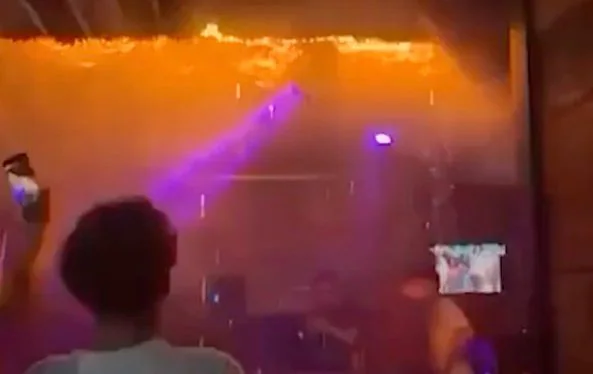
In the Netherlands, the New Year festivities were among the most tumultuous in recent memory. Although the country has moved to phase out private fireworks altogether after this year, the celebrations still featured widespread and unchecked use of powerful devices on crowded streets. The result was tragic: two fatalities — a 38‑year‑old man near Amsterdam and a 17‑year‑old in Nijmegen — along with numerous serious injuries. In total, roughly 250 arrests were made across the country amid disorderly celebrations and clashes with police. Most dramatically, the historic Vondelkerk church in Amsterdam — a Gothic Revival landmark dating back to 1872 — was nearly destroyed by fire hours after midnight, raising alarms about how fireworks near structures can have consequences far beyond individual injuries.
In Belgium, authorities in Brussels and Antwerp reported dozens of incidents in which fireworks were not merely celebratory but actively directed toward police and emergency workers, complicating efforts to maintain order. In several cases, officers and first responders were injured by explosive devices used in a confrontational context — a dramatic shift from the intended playful use of pyrotechnics and a stark demonstration of how fireworks can be weaponized in crowded environments.
France and Italy also recorded elevated rates of fireworks injuries and related emergencies. In Rome, one person died and hundreds were treated for injuries ranging from severe burns to amputations and facial trauma, highlighting how even traditional celebrations can quickly turn dangerous in dense urban settings where devices are handled by untrained individuals.
These incidents are not isolated anomalies; they are part of a troubling pattern across multiple European countries. There, fireworks traveled beyond the sky and into the space where people actually live, work, and walk — leading to predictable yet avoidable harm.
Fireworks Are Not Harmless Toys — They Are Chemical Explosions
At their core, fireworks are engineered chemical devices. They contain oxidizers, metal powders, fuels, and other reactive compounds that, when ignited, generate intense heat, pressure, and kinetic energy. This is not mere “sparkle” — it is a controlled explosion, and when it is not controlled properly, the human body — especially eyes, hands, and faces — suffers the consequences.
What makes fireworks particularly risky at street level is that their combustion products include toxic smoke and irritants, and their explosive force isn’t calibrated for close proximity to people. Components such as metallic powders and oxidizers that produce color and light can also cause chemical burns and inhalation injuries. When these devices are launched amidst crowds instead of from designated, secure zones, they become hazards rather than entertainment.
Is It Still a Tradition — or a Threat?
Across Europe, societies are increasingly questioning whether widespread, unregulated fireworks use makes sense in the modern era:
- The Netherlands is phasing out private fireworks entirely after this year’s traumatic celebrations, reflecting concern over repeated injuries, disorder, and undue demands on emergency services.
- Germany is debating stricter limits on what can be sold and when fireworks may be used, and expanding enforcement against homemade devices that fall outside legal categories.
- Belgium, France, and Italy are reviewing municipal and national fireworks policies in light of documented injuries and disturbances during the holiday period.
Despite these trends, many countries still allow private individuals to buy and ignite powerful pyrotechnics with minimal training or oversight — often in areas where pedestrians, children, and non‑participants are mere meters away from the blast zone.
The experience of this New Year forces an uncomfortable question:
Should devices capable of producing explosions and high‑temperature reactions be freely available to the general public — especially where crowds gather — or should they be relegated to the control of trained professionals on designated sites and times?
In Switzerland, for example, regulations already require licenses and controlled locations for powerful fireworks, and prohibit many high‑intensity devices from private sale. The logic is simple: if something has the potential to injure or kill, the standards for its use should reflect that potential.
Looking Ahead: Safety or Tradition?
New Year 2025–2026 will be remembered by many not just for bright lights and celebration, but for blown‑up hands, sight loss, burns, legal conflicts, and a historic church in ruin — all challenges that go beyond simple revelry.
Fireworks are not inherently evil, but when they are launched casually in crowded streets by untrained hands, they become hazards with real human costs. If next year’s celebrations are to be truly joyful — rather than tragedy‑marked — Europe may have to answer this question:
Are fireworks a symbol of celebration — or of avoidable risk? And if they are the latter, shouldn’t their use be limited to professionals, in safe spaces, and at regulated times?*
Because what this New Year showed is clear: fireworks near people are no longer just sparks in the sky — they are sparks on the ground, with consequences we can no longer ignore.